AI assistant.
AI copilot.
AI chatbot.
AI agent.
Agentic AI.
These terms appear everywhere.
And they are often used as though they mean the same thing.
They do not.
The simplest difference is this:
An AI assistant primarily helps you perform work. An AI agent can be designed to perform parts of the work on your behalf.
Consider an incoming sales lead.
An AI assistant might say:
“Here is a personalised response you could send.”
An AI agent could potentially:
Read the enquiry
↓
Research the company
↓
Check CRM history
↓
Qualify the lead
↓
Create the CRM record
↓
Prepare a personalised response
↓
Schedule the next action
The difference is not necessarily the underlying language model.
It is the architecture, autonomy, tools and authority surrounding the model.
Understanding that difference can help businesses avoid both under-automation and unnecessary complexity.
What Is an AI Assistant?
An AI assistant helps a person complete tasks.
The typical interaction is:
Human asks
↓
AI responds
↓
Human decides what happens next
For example:
“Summarise this report.”
“Write an email.”
“Explain this spreadsheet.”
“Generate ideas for our campaign.”
“Compare these contracts.”
The assistant produces useful output.
But the person generally remains responsible for directing the workflow.
Common AI Assistant Tasks
AI assistants are particularly useful for:
- drafting;
- summarising;
- brainstorming;
- research;
- analysis;
- translation;
- document review;
- meeting preparation;
- coding assistance;
- question answering;
- knowledge retrieval.
The key feature is human direction.
You remain the operator.
What Is an AI Agent?
An AI agent is designed to work toward an objective with a greater degree of independence.
Instead of giving it every individual instruction, you may give it a goal.
For example:
“Qualify every inbound lead and route high-value opportunities to the correct salesperson.”
The agent may then:
- receive the lead;
- analyse the enquiry;
- retrieve relevant data;
- research the company;
- evaluate qualification criteria;
- update the CRM;
- assign the lead;
- create the next task.
The agent controls more of the workflow.
AI Agent vs AI Assistant in One Sentence
A useful mental model is:
Assistant = Help me do it.
Agent = Work toward doing it for me.
But this distinction is a spectrum rather than a perfect binary.
Some assistants can use tools.
Some agents require frequent approval.
Some workflows mix both.
The important question is not what the vendor calls the product.
It is:
Who decides and executes the next step?
AI Agent vs AI Assistant Comparison
| Capability | AI Assistant | AI Agent |
|---|---|---|
| Responds to prompts | Yes | Yes |
| Generates content | Yes | Yes |
| Analyses information | Yes | Yes |
| User directs each major step | Usually | Less often |
| Goal-oriented execution | Limited | Core capability |
| Multi-step planning | Sometimes | Common |
| Uses external tools | Sometimes | Common |
| Updates business systems | Limited/controlled | Can |
| Runs from triggers | Less common | Common |
| Maintains workflow state | Limited | Common |
| Autonomy | Low to moderate | Moderate to high |
| Human involvement | High | Variable |
| Operational risk | Usually lower | Potentially higher |
The Real Difference Is Control
Imagine a customer asks:
“Can I get a refund for order 81927?”
AI Assistant
The assistant might:
- explain the refund policy;
- draft a response;
- tell an employee what to check.
The employee then:
- opens the order system;
- verifies the customer;
- checks the purchase;
- approves the refund;
- processes it;
- sends the response.
The assistant helped.
The human executed.
AI Agent
An appropriately designed agent might:
- verify customer identity;
- retrieve order 81927;
- check the refund policy;
- evaluate eligibility;
- prepare the refund;
- request approval if required;
- execute an authorised refund;
- update the customer record;
- send confirmation.
The AI system participates directly in the operational workflow.
That is a much bigger responsibility.
Prompt Driven vs Goal Driven
Another useful distinction is:
AI Assistant
Prompt driven
You say:
“Research this company.”
Then:
“Summarise the findings.”
Then:
“Write an email.”
Then:
“Create CRM notes.”
You manage the sequence.
AI Agent
Goal driven
You say:
“Research this prospect and prepare it for sales outreach.”
The agent may decide that it needs to:
Research
↓
Analyse
↓
Retrieve CRM history
↓
Create summary
↓
Draft outreach
↓
Update workflow state
You define the objective.
The agent manages more of the route.
AI Assistants Are Not Inferior
This is important.
“Agent” sounds more advanced.
That does not mean an agent is always better.
For many tasks, an assistant is exactly what you want.
Suppose a CEO needs help thinking through a strategic decision.
You probably want:
AI analysis
human judgement
rather than an autonomous system making the strategic decision.
Similarly, an AI assistant may be better for:
- creative work;
- sensitive writing;
- strategic analysis;
- unfamiliar tasks;
- high-impact judgement;
- one-off research.
Automation is not automatically an upgrade.
AI Agents Are Not Fully Autonomous Robots
The word “agent” sometimes creates unrealistic expectations.
An AI agent does not need unrestricted autonomy.
A well-designed agent can operate within boundaries.
For example:
Agent can read invoices
Yes.
Agent can extract invoice data
Yes.
Agent can prepare payment
Yes.
Agent can transfer A$100,000 without approval
No.
Autonomy can be selective.
Levels of AI Autonomy
Instead of thinking only:
Assistant
versus
Agent
think about levels.
Level 1: AI Answers
Example:
“Explain this customer complaint.”
Human performs everything else.
Level 2: AI Recommends
AI says:
“This appears eligible for a refund.”
Human decides.
Level 3: AI Prepares
AI:
- retrieves customer;
- checks order;
- calculates refund;
- prepares action.
Human approves.
Level 4: AI Executes Low-Risk Actions
The agent automatically handles approved routine cases.
Humans handle exceptions.
Level 5: Higher Autonomy
The agent plans and executes larger workflows within defined limits.
Businesses should increase autonomy only when the value justifies the additional risk.
AI Assistant Example for Sales
Imagine a salesperson preparing for a meeting.
They ask:
“Summarise everything we know about this prospect.”
The assistant provides:
- company summary;
- previous interactions;
- possible pain points;
- questions to ask.
The salesperson remains in control.
That is a good assistant use case.
AI Agent Example for Sales
Now imagine the company receives 2,000 leads each month.
An AI agent could potentially:
New Lead
↓
Research Company
↓
Retrieve CRM History
↓
Analyse Requirements
↓
Calculate Qualification Score
↓
Assign Salesperson
↓
Prepare Outreach
↓
Create Follow-Up
The value comes from executing a repetitive workflow at scale.
AI Assistant Example for Customer Support
Customer asks:
“Why was I charged twice?”
The support employee asks an assistant to:
- analyse the issue;
- search policy;
- draft a response.
Employee checks everything and sends the response.
AI Agent Example for Customer Support
An agent might:
Receive Message
↓
Identify Customer
↓
Retrieve Transactions
↓
Detect Duplicate
↓
Check Policy
↓
Prepare Resolution
↓
Approval if Required
↓
Update System
↓
Respond
The difference is operational authority.
AI Assistant Example for Finance
A finance manager uploads monthly results and asks:
“Explain the major variances.”
The assistant analyses the information and drafts commentary.
The finance manager verifies it.
Excellent assistant use case.
AI Agent Example for Finance
An agent could:
Receive Invoice
↓
Extract Data
↓
Check Supplier
↓
Match Purchase Order
↓
Check Duplicate
↓
Route Approval
↓
Update Accounting System
This is a workflow.
Not merely a conversation.
AI Assistant Example for Documents
An employee uploads a contract and asks:
“Find the termination clause.”
The AI assistant identifies it.
AI Agent Example for Documents
An agent could process every new contract:
Contract Uploaded
↓
Classify
↓
Extract Parties
↓
Extract Dates
↓
Extract Renewal Terms
↓
Identify Missing Fields
↓
Store Structured Data
↓
Alert Responsible Employee
Businesses processing high document volumes can explore document processing automation.
Tools Change Everything
The biggest architectural shift occurs when AI gains tools.
Without tools:
AI can tell you what should happen.
With tools:
AI may be able to make it happen.
Tools might include:
- search CRM;
- update CRM;
- query database;
- send email;
- create invoice;
- schedule meeting;
- retrieve order;
- generate document;
- create ticket.
This dramatically increases usefulness.
It also increases risk.
An AI Agent Needs More Than an LLM
A production agent may include:
LLM
Tools
APIs
Memory
RAG
Business Rules
Permissions
Workflow State
Human Approval
Monitoring
That is why building a production agent is different from simply creating a sophisticated prompt.
See our AI agent architecture guide for the technical breakdown.
AI Agent vs Chatbot
Chatbot is another term frequently mixed into this discussion.
A traditional chatbot may follow:
Question
↓
Answer
An AI assistant might provide more flexible:
Conversation
Analysis
Content
An AI agent can add:
Goal
Tools
Actions
Workflow Execution
But modern products increasingly blur these categories.
Therefore, evaluate capabilities rather than labels.
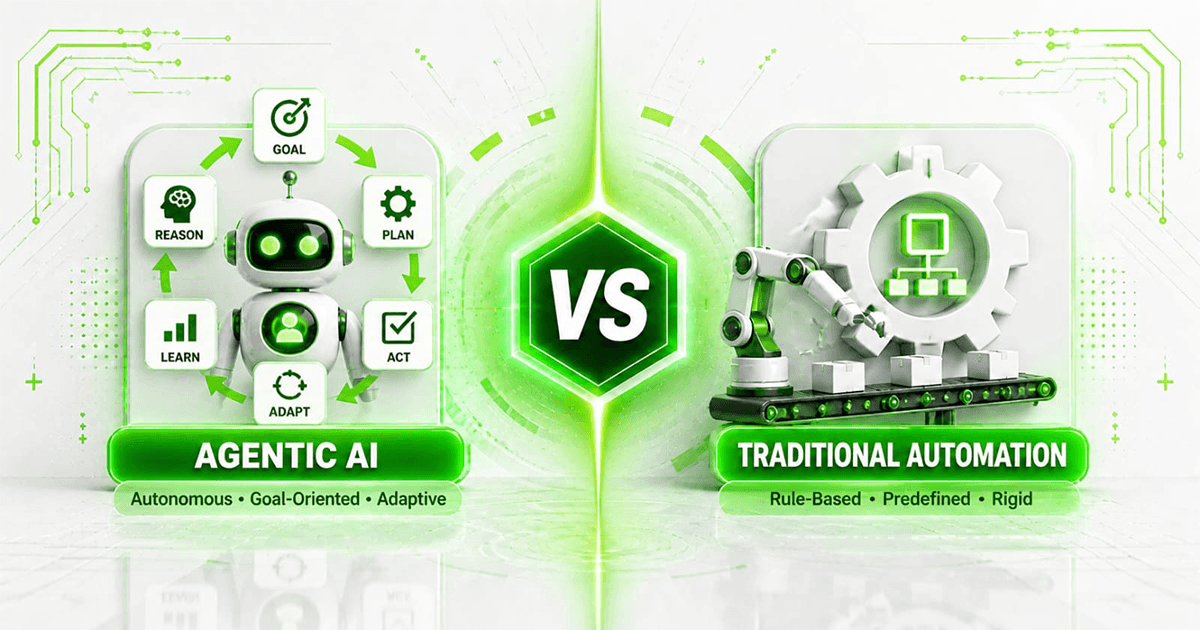
AI Agent vs Automation
Traditional automation follows predefined rules.
For example:
Form submitted
↓
Create CRM record
↓
Send email
The path is predetermined.
An AI agent can potentially make contextual decisions.
For example:
Lead submitted
↓
AI evaluates lead
↓
Does it need research?
↓
Which research?
↓
Does it meet qualification criteria?
↓
Which salesperson is appropriate?
The workflow can become more dynamic.
However, traditional automation remains preferable when deterministic rules can solve the problem reliably.
Assistant vs Agent for High-Risk Work
Consider a legal document.
An AI assistant can:
- summarise;
- highlight clauses;
- compare versions;
- identify questions.
A lawyer remains responsible for the decision.
That can be appropriate.
Now imagine an autonomous agent:
- accepts contract terms;
- signs documents;
- sends commitments.
The risk is dramatically higher.
The lesson is:
More autonomy should require stronger controls.
AI Agent Security
Agents introduce additional security concerns because they can interact with external systems.
Potential risks include:
- prompt injection;
- excessive permissions;
- unsafe tool calls;
- data leakage;
- compromised credentials;
- incorrect autonomous actions.
Businesses should apply:
- least privilege;
- restricted tools;
- authentication;
- approval thresholds;
- monitoring;
- audit logs;
- execution limits.
Our AI agent security guide covers these issues in depth.
Which One Costs More?
Generally, a custom AI agent costs more to build than a simple assistant.
Why?
Because the agent may require:
- integrations;
- tools;
- workflow state;
- monitoring;
- security;
- testing;
- error handling;
- approvals.
An assistant might simply require:
Interface
Model
Knowledge
An agent might require:
Interface
Model
Knowledge
CRM
Database
Tools
Workflow Engine
Monitoring
Security
For detailed budgeting, see AI agent cost in Australia.
When Should You Choose an AI Assistant?
Choose an assistant when:
- humans should control decisions;
- tasks vary significantly;
- work is creative;
- tasks are infrequent;
- consequences are high;
- you mainly need analysis;
- you mainly need drafting;
- the process is not yet understood.
An assistant is also an excellent first step.
Working interactively with AI can help you understand the workflow before automating it.
When Should You Choose an AI Agent?
Consider an agent when:
- tasks happen frequently;
- workflows are understood;
- steps are repetitive;
- data is digitally accessible;
- systems have APIs;
- outcomes are measurable;
- automation has economic value;
- appropriate permissions can be defined.
Agents are particularly interesting when humans currently spend significant time moving information between systems.
AI Agent vs AI Assistant Decision Matrix
| Situation | Better Starting Point |
|---|---|
| Brainstorm marketing campaign | Assistant |
| Analyse one contract | Assistant |
| Draft important executive email | Assistant |
| Research unusual strategic problem | Assistant |
| Process 5,000 invoices monthly | Agent/workflow |
| Qualify 2,000 leads monthly | Agent |
| Update CRM after every meeting | Agent/workflow |
| Answer repetitive support requests | Agent or hybrid |
| Make major strategic decisions | Assistant + human |
| Prepare financial transactions | Agent + approval |
| Execute high-value payment | Human-controlled workflow |
The Hybrid Model
Businesses do not necessarily need to choose one.
A powerful architecture can combine both.
For example:
Employee
↓
AI Assistant
↓
“Analyse today's support problems.”
↓
Assistant identifies issue
↓
Employee says:
“Resolve all eligible low-risk cases.”
↓
AI Agent Workflow
↓
Customer Verification
↓
Account Lookup
↓
Approved Actions
↓
Exceptions Escalated
The assistant becomes the interface.
Agents perform operational work.
AI Assistants Can Control AI Agents
A more advanced architecture might look like:
Business User
↓
AI Assistant
↓
Specialist Agents
For example:
“Prepare our Monday operations report.”
The assistant might coordinate:
Sales Agent
Finance Agent
Support Agent
Operations Agent
Then combine the results.
This begins moving toward a multi agent system.
Do You Need Multiple AI Agents?
Probably not at first.
Start with the simplest architecture that solves the problem.
If one agent can handle the workflow:
use one agent.
If ordinary automation works:
use ordinary automation.
If an assistant is sufficient:
use an assistant.
Multi-agent systems make sense when specialisation creates measurable benefits.
Complexity should solve a problem.
Can an AI Assistant Become an AI Agent?
Yes, conceptually.
Imagine an assistant that already understands natural language.
Now add:
Tools
Workflow State
Goal
Execution Loop
Permissions
It begins behaving more like an agent.
For example:
Assistant
“Here are the five customers who need follow-up.”
Agent
“I identified five customers, prepared the approved follow-ups, sent four, and escalated one because the account requires manager approval.”
The model may be similar.
The surrounding architecture changes.
The Best Question to Ask AI Vendors
Do not ask only:
“Is this an AI agent?”
Ask:
What can it actually do?
What systems can it access?
Can it modify data?
What decisions can it make?
What tools can it call?
What happens without human input?
Which actions require approval?
What happens when it fails?
Are actions logged?
Can permissions be restricted?
These questions reveal far more than the product label.
How to Choose Between an Assistant and Agent
Use this process.
Step 1
Identify the business problem.
Step 2
Map the current workflow.
Step 3
Determine how frequently it occurs.
Step 4
Identify decisions requiring judgement.
Step 5
Identify repetitive actions.
Step 6
Determine what AI should recommend.
Step 7
Determine what AI should execute.
Step 8
Set approval boundaries.
Step 9
Calculate potential ROI.
Step 10
Choose the minimum autonomy required.
That last step matters.
Do not maximise autonomy.
Use the amount necessary to produce the desired outcome.
AI Agent ROI vs AI Assistant ROI
The value models can differ.
An assistant often creates value through:
employee productivity
faster analysis
better drafting
reduced research time
An agent can create value through:
workflow completion
avoided manual work
increased capacity
faster response
avoided hiring
revenue improvement
Measure the outcome rather than simply counting AI usage.
Our AI automation ROI guide provides a framework for doing this.
Building AI Agents With Mintodes
Mintodes builds custom AI agents for business workflows that require more than conversational assistance.
Depending on the use case, an agent can combine:
- AI models;
- RAG;
- memory;
- APIs;
- CRM integrations;
- document processing;
- custom tools;
- workflow orchestration;
- human approvals;
- monitoring;
- security controls.
But not every business problem needs an agent.
Sometimes an assistant is better.
Sometimes traditional automation is better.
Sometimes a hybrid system is best.
The objective should be:
Use the minimum level of AI autonomy necessary to create the required business outcome.
Businesses exploring practical opportunities can also review 25 AI workflows businesses can automate and Mintodes case studies.
Frequently Asked Questions
What is the difference between an AI agent and an AI assistant?
An AI assistant primarily helps a human perform tasks, while an AI agent can be designed to pursue a goal and execute multiple steps using connected tools with less ongoing human direction.
Is ChatGPT an AI assistant or an AI agent?
The distinction depends on how a system is configured and used. Conversational AI commonly behaves as an assistant, while tool access, workflow execution and greater autonomy can enable agent-like behaviour.
Are AI agents better than AI assistants?
No. Assistants are often better when humans should remain closely involved. Agents are useful for repeatable workflows where greater automation creates measurable value.
Can AI agents use business software?
Yes. Properly designed agents can interact with authorised APIs and tools such as CRM, databases, calendars, document systems and other business applications.
Are AI agents fully autonomous?
They do not have to be. Agents can operate with approval checkpoints and strict permission boundaries.
Is an AI chatbot the same as an AI agent?
Not necessarily. A chatbot may primarily provide conversational responses, while an agent can be designed to execute actions across systems.
What is agentic AI?
Agentic AI generally describes AI systems capable of pursuing objectives, making decisions within defined boundaries and using tools to complete multi-step tasks.
Do AI agents need human oversight?
The appropriate amount depends on risk. High-impact actions may require explicit human approval, while low-risk repetitive tasks can sometimes operate with greater autonomy.
Can AI assistants and agents work together?
Yes. An assistant can provide the user-facing interface while specialised agents execute workflows behind it.
Which is cheaper, an AI assistant or an AI agent?
Assistants are generally simpler. Production agents may require additional integrations, tools, monitoring, security and workflow infrastructure.
Which should my business use?
Use an assistant when people should remain responsible for driving the work. Consider an agent when a repeatable, measurable workflow can safely benefit from greater autonomy.
Final Thoughts
The difference between an AI agent vs AI assistant is not simply terminology.
It changes how work gets done.
With an assistant:
You remain the driver.
AI helps you:
- think;
- research;
- analyse;
- write;
- decide.
With an agent:
You define more of the destination.
The system can potentially:
- plan;
- retrieve;
- decide;
- use tools;
- execute;
- verify;
- escalate.
That increased autonomy can produce enormous value.
It also creates additional:
- cost;
- complexity;
- security risk;
- operational responsibility.
So do not choose an agent simply because it sounds more advanced.
Choose an assistant when assistance is enough.
Choose an agent when workflow execution creates measurable value.
And combine the two when your business needs both intelligence and controlled automation.
The best AI system is not the one with the most autonomy.
It is the one with the right level of autonomy for the job.