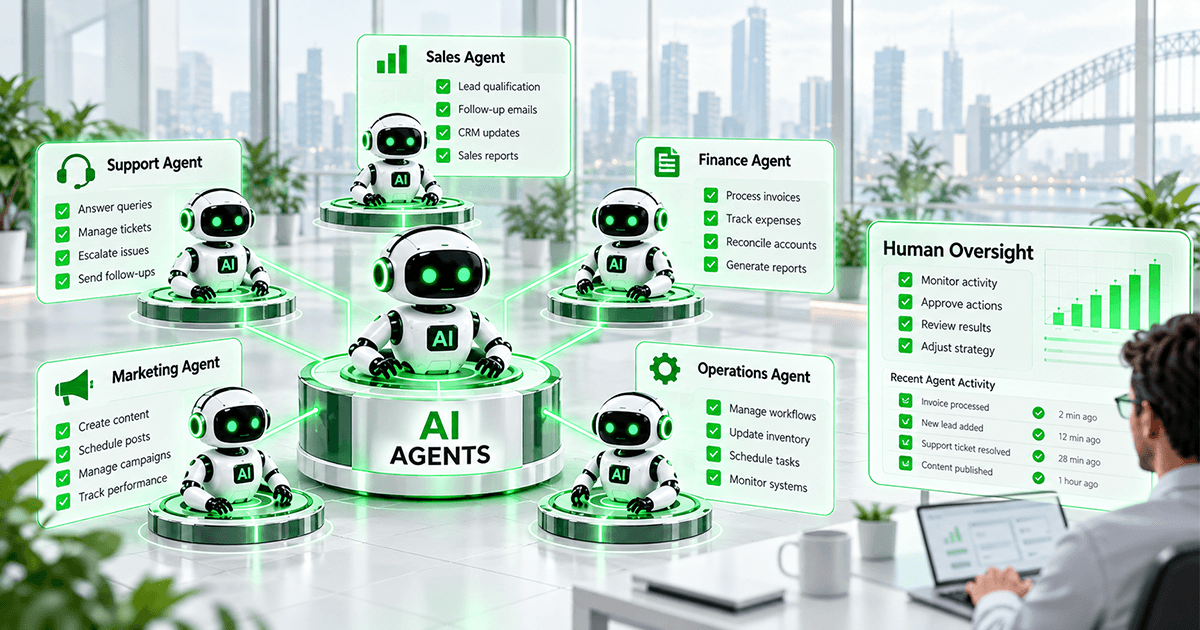
Australian small businesses do not have an AI problem. Most have a workflow problem.
A customer enquiry arrives, but nobody enters it into the CRM until later. A supplier invoice lands in an inbox and is retyped into Xero. A job is completed, but the invoice is raised two days later because somebody has to remember. A weekly report takes half a Friday because the numbers sit across three systems.
None of these problems looks dramatic on its own. Together, they quietly consume hours every week. This is where AI automation for small business becomes useful: not as another chatbot or software subscription, but as a way to remove repetitive work between the systems your business already uses.
Australia had more than 2.8 million actively trading businesses at 30 June 2026 according to the Australian Bureau of Statistics. The practical question is therefore changing from whether a business should experiment with AI to which part of the operation software should handle so people do not have to keep doing it manually.
What Should a Small Business Automate First?
Start with a workflow that is frequent, measurable and annoying. Do not start with the most impressive AI idea. Start with the work your team keeps doing by hand.
- It happens many times each week.
- It involves copying, checking, classifying or following up.
- The normal rules are already understood.
- A person can still review exceptions or important decisions.
For many Australian businesses, that points to lead intake, quote preparation, CRM updates, invoices, document handling, inbox triage, payment follow-up or reporting.
What Does AI Automation Mean for a Small Business?
AI automation combines ordinary software automation with artificial intelligence when the workflow needs to interpret something. A simple rule such as job marked complete → create draft invoice → notify accounts does not need AI. Reading a customer email, understanding what they need, extracting details, deciding which service it relates to and updating the CRM may require AI because the input is less predictable.
- Emails written in natural language
- PDFs with different layouts
- Customer enquiries with missing information
- Support messages that need categorising
- Leads that require first-pass qualification
- Documents containing fields that need extracting
- Notes that need converting into structured information
The rest of the workflow can still use conventional software rules. Use deterministic software when the answer is predictable, AI when interpretation is genuinely required, and human approval where judgement or authority matters. If this is the kind of system you need, see our AI workflow automation service.
12 AI Automation Examples for Australian Small Businesses
The best automation is not the one with the most AI. It is the one that removes a costly handoff without creating a new problem. Here are 12 practical workflows worth assessing.
1. Lead Intake and Qualification
A lead arrives through a website form, email, social channel or referral. Somebody reads the enquiry, decides whether it is relevant, enters the details into the CRM, assigns it and sends a reply. A workflow can capture the enquiry as soon as it arrives, extract the important information, create or update the CRM record and apply your qualification rules.
- Send an acknowledgement
- Ask for missing information
- Assign the lead to the right salesperson
- Offer a booking link
- Create a follow-up task
- Flag a high-value enquiry for immediate attention
AI is useful when customers explain what they need in free text. Complex pricing, unusual requirements and final sales judgement should remain human decisions.
2. Quote and Proposal Preparation
Quotes often contain more repeated work than businesses realise. A salesperson may read meeting notes, open the CRM, find an older proposal, copy relevant sections, change the scope, add customer information, check pricing, format the document and send it for approval.
A workflow can prepare much of that before the salesperson touches the document. Approved customer information can come directly from the CRM, pricing can come from controlled rules, the correct template can be selected automatically and AI can turn rough meeting notes into a structured first draft. A person still checks scope, commercial terms and final price.
3. CRM Updates and Sales Administration
A CRM is useful only when its information is current. Automation can log form submissions, selected email activity, follow-up tasks, deal-stage changes, company enrichment, missing fields, stale opportunities and routing rules.
The result is not simply less data entry. Management gets a pipeline that reflects what is actually happening. See our CRM and sales automation service for the implementation side.
4. Supplier Invoice Capture
An invoice arrives as a PDF. Somebody opens it, reads the supplier, invoice number, date, GST, total, line items and purchase-order information, then types those details into accounting software.
- Capture the invoice from email or an upload folder
- Identify the document type
- Extract the required fields
- Validate the extracted information
- Check for duplicates
- Compare the data with supplier or purchase-order records
- Send uncertain items to a review queue
- Create a draft bill in Xero or MYOB
The most important step is not extraction. It is validation. A production system should know when it is uncertain. For this workflow, see document processing automation and finance automation.
5. Accounts Receivable and Overdue Follow-Up
Getting an invoice out is only half the process. A workflow can monitor invoice status and due dates, then trigger approved follow-up steps: invoice due → no payment recorded → reminder → wait → second reminder → human follow-up.
Sensitive situations should still be escalated. Disputes, payment arrangements and valuable customer relationships require context. Automation provides consistency while people handle exceptions.
6. Document Classification and Data Extraction
- Application forms
- Contracts
- Purchase orders
- Onboarding documents
- Compliance records
- Resumes
- Statements
- Certificates
- Claims
- Service reports
These documents may arrive in different layouts while containing the same underlying information. AI can classify the document, find the required information and route it into the correct workflow. If the AI is uncertain, the answer should never be to guess.
7. Shared Inbox Triage
Shared inboxes often become invisible workflow systems. Sales, billing, complaints, supplier messages and support requests all live there, and somebody has to decide where every new email belongs.
- Identify new sales enquiries
- Separate billing from support
- Detect urgent complaints
- Match messages to existing customers
- Add information to the CRM
- Draft routine responses
- Assign messages to the correct employee
A safer pattern is routine plus low risk → automate; important plus unusual → prepare and escalate.
8. Customer Support and Knowledge Answers
Modern AI chatbots can work from approved business knowledge such as documentation, service information, policies, pricing rules, help articles, onboarding material and internal procedures. The important word is approved. A business chatbot should not be encouraged to improvise. See AI chatbot development.
9. Appointment Scheduling and Reminders
Booking includes identifying the appointment type, finding an available employee, collecting information, confirming, reminding, rescheduling, updating the CRM and notifying the team. Most steps are predictable and can be automated without AI. AI becomes useful when the initial request arrives in natural language.
A language model can interpret the request. The actual availability check, booking creation and CRM update should still run through controlled integrations.
10. Customer and Employee Onboarding
Onboarding is repetitive because the same chain of actions happens every time. One approved trigger can start the sequence.
- Create CRM or internal records
- Create projects or shared folders
- Send approved welcome messages
- Generate tasks and access requests
- Request missing documents
- Create billing details
- Assign training and policy acknowledgements
- Notify the relevant delivery or management team
The biggest benefit is consistency. A growing company no longer depends on one experienced employee remembering every small onboarding task.
11. Weekly Management Reporting
Someone exports information from the CRM, downloads figures from accounting software, pulls operational data from another platform, puts everything into a spreadsheet and writes a summary explaining what changed.
A reporting workflow can collect approved data automatically. The underlying figures should come from trusted systems. AI can help turn those figures into a readable summary. Software calculates the numbers; AI helps explain the numbers.
12. Moving Data Around Legacy Systems
Many established businesses have one old system nobody wants to replace. The problem appears around it: employees export files, re-enter customer records, update newer tools and compare systems to make sure the information matches.
Sometimes the smarter first step is not replacement. It is integration through an API, database bridge, scheduled file exchange or controlled interface automation. See legacy system automation.
How Do You Decide What to Automate First?
A first automation should be chosen by business value, not novelty. Assess frequency, manual effort, business impact, technical feasibility and where human review must remain.
A Simple Automation Prioritisation Score
Score each candidate workflow from 1 to 5 for frequency, hours consumed, cost of mistakes, ease of integration and clarity of rules. The highest score does not automatically win, but the exercise forces the team to discuss operational value rather than whichever AI idea sounded most impressive.
A Small-Business ROI Example
Imagine a five-person professional-services business. Across lead entry, quote preparation and follow-up, the team spends about 12 hours each week on repetitive administration. If the loaded employment cost of that work averages A$45 an hour, the illustrative weekly cost is A$540. Across 48 working weeks that is A$25,920 per year.
This is an illustrative calculation, not a promised saving. The automation does not need to recover all 12 hours to matter. If a reliable workflow removes half of the handling time, the business can compare that recovered capacity with implementation cost, software licences, hosting, AI model usage, support and maintenance.
When AI Is the Wrong Tool
AI should not be inserted into every workflow. Payment received → update invoice status is a normal software rule. Nothing needs interpreting, so a deterministic integration will usually be faster, cheaper and more predictable.
- The process happens rarely
- The process changes constantly
- Employees disagree about the correct workflow
- The input data is unreliable
- An error could create serious consequences
- Human oversight cannot be provided
- Required systems cannot be accessed reliably
- The expected saving is smaller than the implementation cost
Do not automate a process nobody understands. If five employees perform the same task in five different ways, standardise the process first.
How Much Does AI Automation Cost for an Australian Small Business?
There is no useful single market price because AI automation can mean anything from a small workflow to a custom application running several business-critical processes. Scope matters. For current Mintodes ranges, use the pricing page rather than relying on an old article figure.
- Staff hours currently spent each week
- Loaded cost of those hours
- Error and rework cost
- Revenue lost through delays
- Implementation cost
- Ongoing hosting and software costs
- Realistic percentage of work that can be removed
Australian Privacy and AI: What Small Businesses Need to Check
Privacy cannot be added after the workflow is built. The Office of the Australian Information Commissioner notes that privacy obligations can apply to personal information entered into or generated by AI systems, and its guidance stresses due diligence, privacy risk, transparency and appropriate human oversight.
- What personal information enters this workflow?
- Do we actually need all of it?
- Which provider processes the information?
- Where is that information stored?
- Who can access it?
- Can high-risk fields be removed or masked?
- How long is the data retained?
- Can the provider use it for model training?
- Which decisions need human approval?
- Is every important action logged?
- What happens when the AI is uncertain?
How to Implement Your First Automation Without Disrupting the Business
Step 1: Map the Real Workflow
Do not begin with the process document. Watch the process. Write down what triggers it, what information enters, which systems are involved, which decisions occur, where somebody copies information, which exceptions happen, who approves the result and what marks the process complete.
Step 2: Measure the Baseline
Record the current volume, handling time, error rate, waiting time, rework and missed actions. If you do not measure the old process, you will struggle to prove the new one improved anything.
Step 3: Separate Rules From Judgement
Mark each step as deterministic, interpretation required or human approval required. This prevents AI from being placed where normal software is better.
Step 4: Build the Smallest Useful Version
Do not automate an entire department first. Automate one complete workflow. A narrow system that reliably handles real work is more valuable than an enormous prototype that fails on exceptions.
Step 5: Run It Alongside the Existing Process
Test it on real cases, including awkward ones. Compare the outputs, check failures and keep a rollback path. The automation should earn trust before it becomes the only path.
Step 6: Expand After the First Workflow Proves Itself
Once one workflow shows measurable value, use those results to choose the next opportunity. Automation becomes an operating capability workflow by workflow, not through one giant AI-transformation project.
What Makes an Automation Production Ready?
A demo works when everything goes right. Real systems receive missing information, duplicate requests, bad files, unexpected formats, API failures, internet outages, incorrect user input, expired credentials and edge cases nobody mentioned during discovery.
- Validation
- Retry rules
- Duplicate prevention
- Permissions
- Activity logs
- Failure alerts
- Human review queues
- Named ownership
- Recovery procedures
- Documentation
- Monitoring
Instead of asking only whether the automation works, ask what happens when it does not. The answer tells you much more about whether the system is ready for the business.
Frequently Asked Questions
Is AI automation worth it for a small business in Australia?
It can be when the target workflow happens frequently, consumes measurable staff time and can be automated without creating disproportionate risk. Start with one process and compare expected savings with implementation and running costs.
What is the best AI automation for a small business?
There is no universal best automation. Lead intake, CRM updates, invoice processing, document extraction, inbox triage and reporting are often strong candidates because they are repetitive and measurable.
Can a small business automate Xero or MYOB?
Yes. Many finance workflows can connect with Xero or MYOB through their APIs. Common examples include invoice capture, draft bill creation, payment-status workflows, reconciliation support and updates from operational systems. Important approvals should remain with authorised people.
Do I need an AI agent?
Not necessarily. Many workflows are better handled by conventional automation. An AI agent becomes more useful when a process requires context, interpretation or multi-step decisions that cannot be expressed cleanly through fixed rules.
Is Zapier, Make or n8n enough?
Sometimes. Zapier and Make work well for straightforward cloud-software workflows. n8n provides more control for complex or self-hosted automation. Custom code becomes useful when the process requires unusual integrations, deeper logic, higher reliability or a purpose-built interface.
How long does AI automation take to implement?
A focused workflow can be delivered within weeks. Larger systems take longer because integration, exception handling, security, testing and handover matter just as much as the central automation.
Will AI replace employees in a small business?
That should not be the starting objective. The more useful target is low-value coordination work. People should keep the parts requiring judgement, customer context, negotiation, accountability and exception handling.
How do I know whether a process is ready to automate?
You should be able to explain what starts it, what information it requires, what outcome it produces, what the normal rules are, which exceptions occur and who handles those exceptions. If the team cannot agree on those basics, standardise the process before automating it.
Start With the Sentence Your Team Says Every Week
Listen for this sentence: every time this happens, somebody has to… Somebody has to enter it into Xero. Somebody has to update the CRM. Somebody has to chase the invoice. Somebody has to check the inbox. Somebody has to prepare the report. Somebody has to move the information from the old system into the new one. That is where you start.
Start with one repeated piece of work that has a clear cost. Map it. Measure it. Automate the predictable parts. Keep people on the decisions that matter. Then prove the result before expanding.
If you want to find the first workflow worth automating, start with a free automation audit. Bring one process that wastes time every week. The first question should not be how to automate it. The first question should be whether it is worth automating at all.