Choosing an AI agent development company is surprisingly easy if all you want is a demo.
Give a developer a clean example, connect an AI model to a couple of tools and show the system completing a perfect workflow.
It looks impressive.
Then real customers start using it.
An email arrives without the information the agent expected.
The CRM contains two contacts with similar names.
An API stops responding.
A customer changes their request halfway through the conversation.
The same form is submitted twice.
The AI confidently chooses an action that makes sense linguistically but violates a business rule.
That is where the difference between an AI demonstration and a production business system becomes obvious.
If an Australian business is hiring an AI agent development company, the most important question is not:
"Which AI model do you use?"
It is:
"What happens when the agent is wrong?"
The answer tells you far more about the quality of the system you are about to buy.
What Does an AI Agent Development Company Actually Build?
An AI agent development company builds software that allows artificial intelligence to participate in business workflows rather than simply generate text.
A useful AI agent might be able to:
- understand an incoming enquiry;
- retrieve information from approved systems;
- determine which workflow applies;
- use permitted software tools;
- update a CRM;
- search business knowledge;
- prepare documents;
- create tasks;
- check scheduling information;
- request missing information; and
- escalate unusual situations to a person.
The AI model is only one component.
A production system may also require:
- APIs;
- databases;
- authentication;
- workflow logic;
- CRM integrations;
- document processing;
- business rules;
- permissions;
- validation;
- logging;
- monitoring; and
- human approval processes.
That is why choosing an AI agent developer should look more like choosing a software engineering partner than buying a chatbot.
Start With the Workflow, Not the AI
A good development conversation should begin with the business process.
Imagine a company says:
"We want an AI sales agent."
That is not yet a useful specification.
What does the sales agent actually need to do?
Perhaps the real workflow is:
New enquiry arrives → identify service required → check service area → retrieve or create CRM contact → collect missing information → qualify enquiry → assign salesperson → create follow-up
Now the project can be discussed properly.
Some steps may require AI.
Others do not.
Creating a CRM record is a deterministic software action.
Understanding a customer's free-text description may require AI.
Checking whether a postcode belongs to a defined service area can be ordinary business logic.
Deciding whether an unusual enterprise enquiry should be escalated may combine rules with AI interpretation.
A capable development company should separate these components rather than putting an AI model in charge of everything.
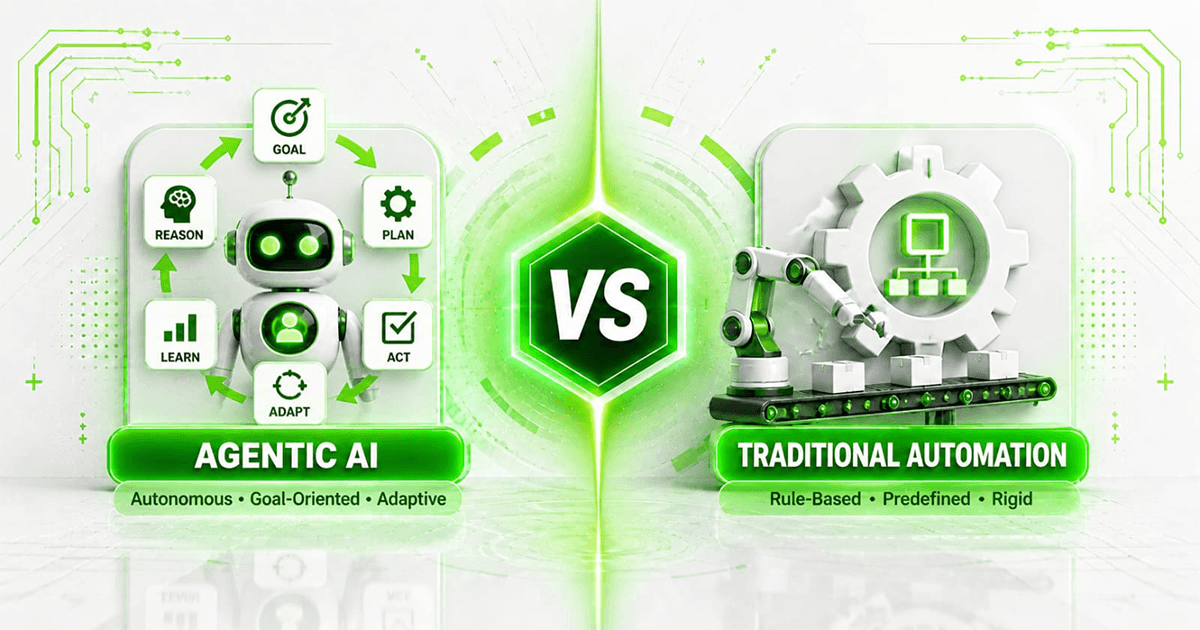
AI Agent Development vs AI Automation
Businesses sometimes approach an AI company when they actually need automation.
Suppose your workflow is:
New Shopify order → create accounting record → update inventory → send internal notification
There is little ambiguity.
Normal workflow automation may be the better solution.
Now consider:
Customer email arrives → understand request → identify customer → retrieve account information → determine which process applies → perform approved action
That contains interpretation.
An AI agent becomes more useful.
Many production systems use both.
Automation handles predictable execution.
AI handles information that needs interpretation.
Your development partner should be comfortable telling you when AI is unnecessary.
A company that recommends an AI agent for every problem may be optimising for selling AI rather than solving the workflow.
What Should You Look for in an AI Agent Development Company?
The website will probably mention LLMs, agents, automation and integrations.
Those words tell you very little.
Look deeper.
1. They Ask About the Existing Process
Before discussing models, a good development team should want to understand:
- what triggers the workflow;
- what information enters;
- which systems are involved;
- what decisions occur;
- where employees currently intervene;
- what exceptions happen;
- what the final outcome is; and
- what an error would cost.
If discovery begins with:
"Which chatbot do you want?"
the conversation may already be too narrow.
2. They Can Explain Why AI Is Needed
Ask which parts of the proposed system actually require AI.
You should get a specific answer.
For example:
"AI is needed here because customers describe the problem in unstructured language. The rest of the process can use deterministic rules."
That is more convincing than:
"We use AI throughout the workflow."
The best architecture is not the one containing the most AI.
It is the simplest architecture that can perform the job reliably.
3. They Understand Integrations
An AI agent becomes substantially more useful when it can work safely with the software the business already uses.
That may include:
- CRMs;
- accounting platforms;
- calendars;
- email;
- job-management systems;
- databases;
- document stores;
- internal APIs; or
- legacy software.
Ask how integrations are implemented.
A prototype that copies information into a spreadsheet is very different from a production system that reliably interacts with core business software.
4. They Design for Human Escalation
An agent should have somewhere to go when it cannot safely continue.
Ask:
What happens when information is missing?
What happens when confidence is low?
What happens when the customer asks for something outside the workflow?
What happens when an action requires approval?
Who receives the exception?
"I don't know" can be an excellent AI response when the alternative is taking the wrong action.
5. They Think About Failure Before Launch
Real systems fail.
APIs become unavailable.
Credentials expire.
Customers provide bad information.
Documents arrive in unexpected formats.
Records are duplicated.
The AI misunderstands something.
Ask the development company how the system handles those situations.
Production engineering should include concepts such as:
- validation;
- retry behaviour;
- timeouts;
- duplicate prevention;
- failure alerts;
- audit logs;
- review queues;
- recovery procedures; and
- monitoring.
If none of this appears in the project discussion, you may be looking at a prototype rather than an operational system.
Ask to See Real Production Work
A polished AI demonstration is useful, but it does not answer the most important questions.
When reviewing an AI agent development company, ask about systems that have actually been used in production.
You are trying to understand:
- what business problem was solved;
- what systems were integrated;
- what the agent was allowed to do;
- where humans remained involved;
- what happened when something failed; and
- how success was measured.
A case study does not need to expose confidential client information to be useful.
It should demonstrate that the company understands the difference between making AI work once and making it work repeatedly.
Ask What the Agent Is Allowed to Do
AI agent permissions deserve their own conversation.
Suppose an agent has access to a CRM.
Does it have permission to:
Read contacts?
Create contacts?
Modify every field?
Delete records?
Export customer data?
Those are very different levels of access.
Apply the same thinking to email, finance software, calendars, databases and internal tools.
A useful principle is least privilege.
Give the agent the minimum access necessary to complete its job.
If it only needs to read appointment availability, it does not need permission to delete appointments.
If it needs to create draft invoices, that does not automatically mean it should be allowed to approve payments.
AI autonomy should be bounded by the workflow.
Ask How Human Approval Works
"Human in the loop" sounds reassuring.
It means very little unless the approval process is defined.
Consider a quote-generation agent.
The system prepares a quote.
What happens next?
Does someone receive a notification?
Where do they review it?
Can they see which information the AI used?
Can they edit the result?
Does the quote remain blocked until approval?
Is the approval recorded?
What happens if nobody reviews it?
That is an actual human-in-the-loop workflow.
A button labelled Approve in a demo is not enough.
Ask How the Agent Knows What It Knows
AI systems often need business knowledge.
That could include:
- product information;
- procedures;
- policies;
- pricing rules;
- technical documentation;
- contracts;
- FAQs; or
- customer records.
Ask where that information comes from.
A production agent should be designed around approved sources rather than being encouraged to answer everything from the model's general knowledge.
For an internal knowledge agent, you might want the system to answer only from company documentation.
For a customer agent, pricing might need to come from a database or controlled pricing system.
The source of truth should be deliberate.
Ask How the Company Handles Hallucinations
No serious AI developer should promise that a language model will never produce an incorrect answer.
The better question is how the system limits the consequences.
Different workflows require different controls.
For example:
Customer knowledge question
Retrieve relevant approved documentation before generating the answer.
Appointment booking
Use real calendar availability rather than allowing the model to invent times.
Invoice processing
Validate extracted information and send uncertain cases to review.
CRM updates
Restrict fields and validate important identifiers.
Financial actions
Require deterministic controls and appropriate human approval.
The solution to hallucinations is not simply writing a longer prompt.
System architecture matters.
Ask How Testing Is Performed
Do not accept a test process based only on ten clean examples.
A useful AI agent needs adversarial and edge-case testing.
Ask whether testing includes:
- missing information;
- contradictory information;
- duplicate requests;
- invalid data;
- unexpected document formats;
- API failures;
- unavailable tools;
- unusual customer language;
- requests outside the agent's permissions; and
- attempts to make the agent ignore its instructions.
If the agent communicates with customers, test interruptions, ambiguity and changes of mind.
If it processes documents, test bad scans and unexpected layouts.
If it modifies business records, test duplicate and incorrect identifiers.
The objective is not to demonstrate that the system succeeds.
It is to discover how it fails before customers do.
Ask How Performance Will Be Measured
AI projects can easily become subjective.
Someone watches the agent work and says:
"That's impressive."
That is not a business metric.
Before development, agree on what improvement means.
Depending on the workflow, measure:
- handling time;
- response time;
- successful completion rate;
- escalation rate;
- error rate;
- manual interventions;
- rework;
- leads processed;
- appointments booked;
- documents processed; or
- hours of repetitive work removed.
Measure the old process first.
Otherwise, there is no baseline against which to judge the new system.
Ask About Monitoring After Launch
An AI agent is not finished when it reaches production.
The environment changes.
APIs change.
Business rules change.
Employees change processes.
Customers discover unexpected ways to interact with the system.
Model providers can change behaviour.
A production agent therefore needs monitoring.
Depending on the application, that may include:
- failed tool calls;
- response latency;
- escalations;
- unusual outputs;
- token or model usage;
- integration errors;
- workflow failures; and
- cost.
Ask who is responsible for monitoring these signals.
Also ask what happens when something breaks.
A system nobody owns after launch is a future problem.
Ask About Data and Privacy
An AI agent may interact with considerably more data than a standalone chatbot.
Depending on the workflow, it might process:
- names;
- email addresses;
- phone numbers;
- customer records;
- employee information;
- invoices;
- contracts;
- support conversations; or
- internal documents.
Australian businesses should understand applicable privacy obligations and consider current guidance from the Office of the Australian Information Commissioner when AI systems handle personal information.
Questions for a potential development partner include:
- What data is sent to AI providers?
- Which providers receive it?
- Where is it processed?
- Where is it stored?
- How long is it retained?
- Can provider systems use it for model training?
- Can sensitive fields be excluded?
- How are permissions controlled?
- Are important actions logged?
- How is access revoked?
- What happens to data when the engagement ends?
"We use a secure AI model" is not a sufficient answer.
You need to understand the data flow.
Ask Who Owns the System
This question is easy to forget until the relationship changes.
Clarify ownership of:
- source code;
- workflow configurations;
- prompts;
- documentation;
- cloud infrastructure;
- API accounts;
- domain-specific knowledge bases;
- databases; and
- credentials.
Also ask whether the system can operate without the development company.
There may be legitimate reasons for ongoing managed services, but the commercial arrangement should be explicit.
Avoid discovering six months later that a business-critical workflow lives entirely inside accounts the client does not control.
Ask About Documentation and Handover
A production system should not exist only inside a developer's head.
Documentation should explain enough for the system to be operated and maintained.
Depending on the project, that could include:
- architecture;
- integrations;
- workflow logic;
- permissions;
- environment configuration;
- escalation behaviour;
- monitoring;
- known limitations;
- deployment procedures; and
- recovery steps.
If the employee who built the system disappears tomorrow, somebody should still be able to understand what is running.
Red Flags When Choosing an AI Agent Development Company
No single warning sign proves a company is unsuitable.
Several together should make you investigate further.
"The Agent Is 100% Accurate"
Language models are probabilistic systems.
Ask what 100% actually means, what test set was used and what happens outside those cases.
"It Can Automate Everything"
Probably not responsibly.
Different processes have different risks, integrations and exception rates.
No Interest in Your Current Workflow
If the provider jumps immediately to the technology without understanding the process, they may be building the product they want rather than the system you need.
No Discussion of Exceptions
Normal cases make good demos.
Exceptions determine whether the system survives production.
No Human Escalation
A business agent needs a path for situations it cannot safely resolve.
Excessive AI Where Rules Would Work
If every step is being delegated to an LLM, ask why.
Deterministic software is often cheaper, faster and more reliable for deterministic problems.
Broad Permissions by Default
An agent should not receive unrestricted access to core business systems simply because that is easier to implement.
No Measurement Plan
If nobody defines what success means, the project can become an expensive technology demonstration.
Should You Hire an AI Agency, Freelancer or Internal Developer?
There is no universally correct choice.
The project determines the answer.
Freelancer
A freelancer can make sense for a narrow project when requirements are clear and the necessary skills fit one person's expertise.
The risk increases when the system requires several disciplines: backend engineering, AI, infrastructure, security, integrations and ongoing support.
AI Development Company
A development company can make more sense when the workflow spans multiple systems or requires ongoing engineering and support.
The important factor is not company size.
It is whether the team has the relevant production skills.
Internal Team
An internal team offers close access to business knowledge and long-term control.
It also requires the organisation to hire or develop the engineering capability needed to build and maintain the system.
Some businesses use a hybrid approach: an external development partner builds the initial system while internal employees own business rules and gradually take greater operational responsibility.
How Much Does AI Agent Development Cost?
There is no sensible universal figure.
A basic internal knowledge agent and a production system integrated across several business applications are not comparable projects.
Cost is usually influenced by:
- workflow complexity;
- number of integrations;
- API quality;
- data preparation;
- interface requirements;
- AI usage;
- security;
- permissions;
- human-review workflows;
- testing;
- deployment;
- monitoring; and
- ongoing support.
An apparently simple requirement can become complicated if the underlying systems do not expose reliable APIs.
Likewise, an advanced-sounding AI workflow can sometimes be relatively straightforward if the surrounding infrastructure is clean.
For current Mintodes implementation ranges, refer to the pricing page.
Do Not Compare Quotes Only by Price
Imagine two proposals.
Company A: A$8,000
Company B: A$18,000
Company A appears cheaper.
But suppose the first proposal includes:
- a basic agent;
- two integrations; and
- deployment.
The second includes:
- discovery;
- process mapping;
- production integrations;
- validation;
- permission controls;
- testing;
- monitoring;
- documentation;
- staff handover; and
- post-launch support.
They are not necessarily quotes for the same product.
Before comparing prices, compare scope.
Ask each provider to explain:
What is included?
What is excluded?
What happens after launch?
Who pays third-party usage costs?
What ongoing maintenance is expected?
A lower implementation price can become expensive if the system requires constant manual intervention.
A Better Way to Evaluate an AI Agent Proposal
You can evaluate a proposal across six areas.
Business Fit
Does the proposed system solve a measurable workflow problem?
Technical Fit
Can it integrate reliably with the systems involved?
AI Fit
Is AI being used only where interpretation is required?
Risk Controls
Are permissions, validation, escalation and human approval clearly defined?
Production Readiness
Does the proposal include testing, monitoring, failure handling and documentation?
Economics
Is the expected operational benefit reasonable relative to implementation and ongoing cost?
A proposal should make sense across all six.
An impressive AI demo cannot compensate for a workflow with no business value.
A Practical Example: Evaluating a Lead-Qualification Agent
Suppose an Australian professional-services company receives 300 enquiries each month.
Employees currently:
- read each enquiry;
- determine the requested service;
- check whether the company can help;
- search for an existing CRM contact;
- create or update the opportunity;
- request missing information;
- assign the enquiry; and
- schedule follow-up.
The business asks three AI companies for proposals.
The first promises an "autonomous AI salesperson."
The second focuses mainly on generating personalised email responses.
The third maps the current process first.
During discovery, it finds that only two parts genuinely need AI:
interpreting the free-text enquiry and determining which service category applies when the wording is ambiguous.
Everything else can use existing CRM APIs and controlled rules.
The resulting system may actually contain less AI.
That can be a good sign.
The objective is not to maximise AI.
The objective is to minimise unnecessary work.
What Should the First AI Agent Project Look Like?
Your first project should usually be narrow enough to measure.
Avoid:
"Build an AI employee for our entire operations department."
Prefer:
"Process inbound website enquiries, collect missing information and prepare qualified leads in the CRM."
A narrow workflow gives you:
- clear inputs;
- clear outputs;
- measurable performance;
- defined permissions;
- manageable testing; and
- identifiable failure cases.
Once that system proves itself, expand.
This is also the approach discussed in our broader guide to AI agents in Australia: build autonomy around a real workflow rather than around the idea of an AI employee.
Questions to Ask Before Signing With an AI Agent Development Company
Take these questions into the first serious project discussion:
- Which parts of our workflow actually require AI?
- Which parts should use conventional automation?
- What systems will the agent access?
- What permissions will it have?
- How do you handle missing or conflicting information?
- What happens when the AI is uncertain?
- Which actions require human approval?
- How are incorrect actions prevented or recovered?
- How will the system be tested?
- How will performance be measured?
- What monitoring exists after launch?
- Who owns the code and infrastructure?
- What documentation will we receive?
- How is customer and company data handled?
- What ongoing costs should we expect?
- What happens if an API or AI provider becomes unavailable?
- How easily can the system be modified as our process changes?
A capable development partner should be comfortable answering these questions.
If asking them makes the sales conversation uncomfortable, that itself is useful information.
Frequently Asked Questions
What does an AI agent development company do?
An AI agent development company designs and builds software that uses AI to interpret information, make bounded decisions and interact with approved business tools. Projects can include integrations, workflow logic, interfaces, permissions, validation, monitoring and human-review processes.
How do I choose an AI agent development company?
Look beyond AI demonstrations. Evaluate the company's ability to understand your workflow, integrate with existing systems, manage permissions, handle failures, implement human escalation, test edge cases and support the system after launch.
What are AI agent development services?
Services can include workflow discovery, AI agent architecture, custom development, system integrations, retrieval and knowledge systems, testing, deployment, monitoring, maintenance and optimisation.
How much does it cost to develop an AI agent?
Cost varies substantially depending on workflow complexity, integrations, data, security requirements, volume and the level of autonomy. A narrow internal agent is different from a production agent interacting with multiple business systems.
How long does AI agent development take?
A focused workflow may be implemented relatively quickly, while larger systems can require substantial integration, testing and security work. The complexity of the surrounding business systems often affects the timeline more than the AI model itself.
Do I need a custom AI agent?
Not always. Existing software or ordinary automation may solve the problem. Custom development becomes more relevant when the workflow is specific to the business, requires several integrations or needs controls that off-the-shelf products do not provide.
Should an AI agent be fully autonomous?
Not necessarily. Autonomy should match the consequences of an error. Many successful systems automate routine low-risk actions while requiring human approval for important or unusual decisions.
Can an AI agent integrate with our existing software?
Often, yes, particularly when the software provides a suitable API. The feasibility and reliability of each integration should be assessed during discovery rather than assumed.
Who should own the AI agent after development?
Ownership should be explicitly defined in the commercial agreement. Businesses should understand who controls source code, infrastructure, data, accounts, documentation and ongoing maintenance.
Choose the Company That Talks About the Boring Parts
AI demos are exciting.
Monitoring is not.
Permission design is not.
Duplicate prevention is not.
API retries are not.
Audit logs are not.
Documentation is definitely not.
But those are often the things separating an AI agent that works during a sales presentation from one a business can depend on every Monday morning.
When evaluating an AI agent development company, pay attention to what happens after the impressive part.
Ask how the system fails.
Ask what the AI cannot do.
Ask where people remain responsible.
Ask how performance will be measured.
Ask who owns the system.
And make sure somebody can explain why an AI agent is the right solution in the first place.
If you have a workflow you are considering for AI, contact Mintodes. We can map the process first, identify where AI genuinely adds value and determine whether an AI agent, conventional automation or a combination of both is the appropriate architecture.