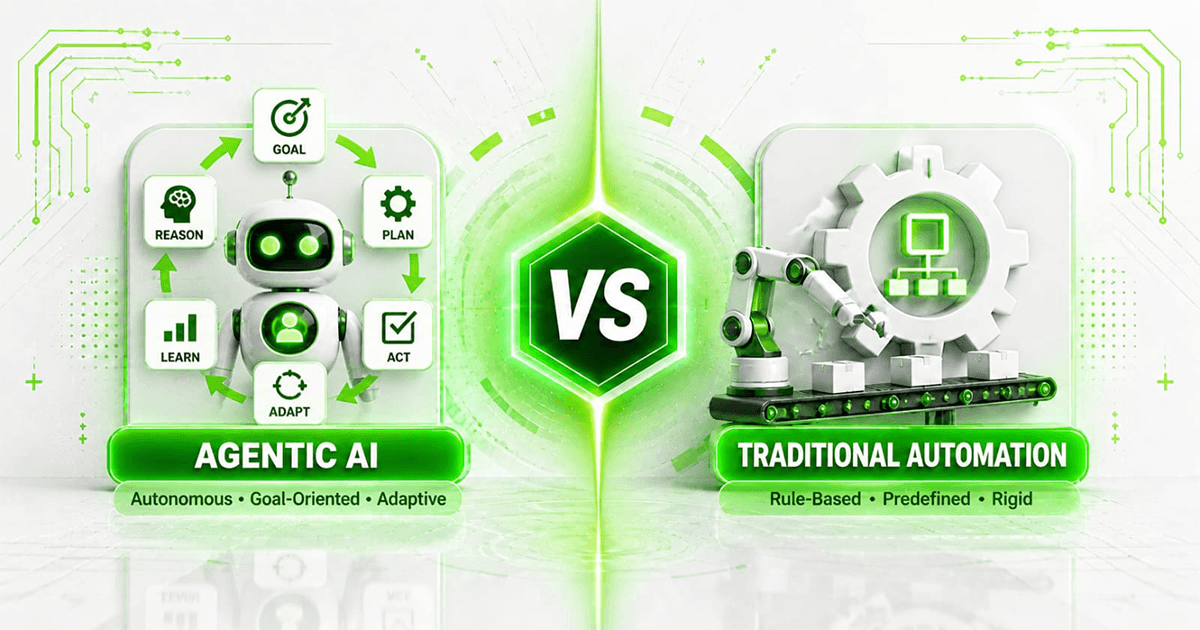
Most businesses already use software that waits to be told what to do.
Someone submits a form. A workflow starts.
Someone clicks a button. A report is generated.
A customer asks a question. A chatbot responds.
Agentive AI changes one important part of that relationship.
Instead of being given every individual step, an AI system can be given an objective and some controlled freedom to decide how to work towards it.
Imagine telling software:
"Review new sales enquiries and prepare the ones worth following up."
A conventional automation needs the process mapped in advance:
New enquiry → check field A → check field B → apply rule → update CRM → notify salesperson.
An agentive system can potentially interpret what the prospect actually wrote, identify missing information, retrieve relevant context, decide which approved tool to use and determine what should happen next.
That sounds like a small distinction.
Operationally, it is a significant one.
But it also creates a new problem.
The more decisions software is allowed to make, the more carefully a business needs to define what it cannot do.
For Australian businesses considering agentive AI, that is the useful place to start.
Not with how autonomous the technology can become, but with how much autonomy a particular workflow actually needs.
What Does Agentive AI Mean?
Agentive AI refers broadly to AI systems that can pursue a goal through a sequence of actions rather than simply generating one response to one prompt.
A normal generative AI interaction might look like this:
Person: Summarise this customer email.
AI: Produces a summary.
An agentive system might instead receive:
Goal: Process this customer enquiry.
It could then:
- interpret the email;
- identify the customer;
- retrieve an existing CRM record;
- determine what information is missing;
- search approved business information;
- choose an appropriate next action;
- update permitted systems;
- prepare or send an approved response; and
- escalate the case if it falls outside its authority.
The difference is not simply that the AI produces better text.
It is that the system can potentially decide what needs to happen next and interact with tools to make that happen.
That is what makes agentive AI interesting for business operations.
It is also what makes control important.
Agentive AI vs Generative AI
Generative AI creates content.
Agentive AI can use generated content as part of a larger process.
Suppose a construction company receives an email requesting a quote.
A generative AI tool could:
- summarise the email;
- extract project details;
- draft a response; or
- rewrite the message into structured notes.
Useful.
But a person still decides what happens with those outputs.
An agentive system could potentially:
read enquiry → extract requirements → check service area → search CRM → identify missing information → create opportunity → request missing details → schedule follow-up
The AI is participating in the workflow rather than producing a standalone answer.
That does not make generative AI obsolete.
Agentive systems often use generative models internally.
The difference is what surrounds the model: goals, tools, memory or context, permissions, workflow state, validation and escalation.
Agentive AI vs AI Agents
The terms agentive AI and AI agents are closely related and are often used inconsistently.
A useful way to think about them is:
Agentive AI describes the broader capability or behaviour: software displaying some ability to plan, choose actions and work towards an objective.
An AI agent is a system built to apply those capabilities to a particular task or environment.
For example, a business might build an AI agent responsible for qualifying incoming sales enquiries.
That agent displays agentive behaviour when it interprets the enquiry, decides which information it needs, uses approved tools and selects the next action.
For a broader introduction to implementation, see our guide to AI agents in Australia.
The terminology matters less than the system design.
Before adopting either label, ask:
What decisions can this software make, what tools can it use, and where does a person regain control?
Those questions tell you far more than whether a product calls itself "agentic", "agentive" or an "AI agent".
Agentive AI vs Traditional Automation
Traditional automation is excellent at predictable work.
For example:
Job marked complete → create invoice draft → notify accounts
There is little ambiguity.
The trigger is known. The actions are known. The result is known.
Adding agentive AI would probably make that workflow more complicated without making it better.
Now consider:
New customer email → determine what they need → check whether we can help → retrieve relevant account information → decide what should happen next
The inputs are less predictable.
Customers describe the same problem in different ways. Information may be missing. Different situations require different paths.
That is where AI can provide the interpretation layer.
In practice, the strongest systems often combine the two.
Agentive AI handles ambiguity.
Traditional automation handles predictable execution.
For businesses building that second layer, workflow automation can connect systems, apply deterministic rules and carry out actions that do not require AI judgement.
The goal is not to replace every workflow with an agent.
It is to put intelligence only where intelligence is useful.
How Does an Agentive AI System Work?
A practical agentive system usually needs several components.
1. A Goal
The system needs a defined objective.
Not:
"Help with sales."
Something closer to:
"Review new website enquiries, collect the information required by our qualification process and prepare qualified opportunities for the sales team."
A narrow goal creates clearer boundaries.
2. Context
The AI needs information relevant to the task.
That could include:
- customer records;
- product information;
- internal procedures;
- previous interactions;
- service areas;
- pricing rules;
- knowledge-base articles; or
- workflow state.
More context is not automatically better.
The system should receive the information necessary for the task, not unrestricted access to everything the company owns.
3. Tools
A useful agent needs ways to interact with the business.
Tools might allow it to:
- search a CRM;
- create a lead;
- query a database;
- check a calendar;
- send an approved message;
- retrieve a document;
- create a support ticket; or
- trigger another workflow.
Tools are where an AI system moves from talking about work to doing work.
They are also where mistakes can become real actions.
Permissions therefore matter.
4. Decision Logic
The agent needs to determine which action is appropriate.
Sometimes that decision can be made by the AI.
Sometimes the decision should remain a hard-coded business rule.
Sometimes it should require human approval.
A production system normally uses all three.
5. Validation
An agent should not blindly trust every result it generates.
Important information can be checked before the next action.
For example, an address might be validated, an invoice number checked for duplicates or a customer ID verified against the CRM.
6. Escalation
A system needs to know when to stop.
If information is missing, confidence is low, a customer is upset or an action falls outside permitted boundaries, the correct next step may simply be:
Give this to a person.
Good agentive AI is not software that refuses to ask for help.
It is software that knows when help is required.
A Simple Example: Processing a Sales Enquiry
Imagine an Australian commercial cleaning company receives this message:
"Hi, we're moving into a new office in North Sydney next month. Around 60 staff, roughly 900 square metres. Looking for cleaning three evenings a week. Could someone send pricing?"
A conventional form may create a CRM entry.
An agentive workflow could do more.
First, it identifies the request as a commercial cleaning enquiry.
It extracts:
Location: North Sydney
Approximate size: 900 m²
Frequency: three evenings per week
Timing: next month
Business size: approximately 60 staff
It checks whether North Sydney is inside the service area.
It searches the CRM to see whether the company already exists.
It compares the enquiry with the information required by the sales process.
Suppose access requirements and preferred start date are missing.
Instead of immediately sending the enquiry to a salesperson, the agent can prepare a short follow-up requesting those details.
Once they arrive, it updates the opportunity and notifies the appropriate salesperson.
Notice what the AI has not done.
It has not invented a final price.
It has not signed a contract.
It has not decided whether an unusual commercial term should be accepted.
The system handles repetitive interpretation and coordination.
People keep the commercial decisions.
Where Can Australian Businesses Use Agentive AI?
Agentive AI becomes useful when employees repeatedly have to interpret information before deciding which routine action comes next.
Sales and Lead Management
An agent can review incoming enquiries, extract details, compare them with qualification rules, update the CRM and prepare the next action.
It can also identify stale opportunities or missing information.
For organisations where CRM administration consumes sales time, these systems can connect with broader CRM and sales automation.
Customer Support
A support agent could classify a request, identify the customer, retrieve approved account information, search internal knowledge and determine whether the issue can be resolved automatically.
More complicated cases can be escalated with the relevant context already assembled.
Document Processing
Documents rarely arrive in identical formats.
An agentive system can potentially identify the document, extract information, validate fields and decide where it belongs.
An invoice may follow one path.
A purchase order follows another.
A document with missing information enters a review queue.
These workflows can be combined with document processing automation.
Finance Operations
Agentive AI can help investigate exceptions rather than simply process perfect transactions.
For example, it could gather information around an invoice mismatch and prepare the issue for an authorised employee.
Financial approval and movement of money should remain tightly controlled.
Internal Operations
Businesses accumulate procedures across documents, emails, wikis, shared drives and employees' heads.
An internal agent can help find information, interpret a request and initiate the correct internal process.
The challenge is ensuring that its source information is accurate and that permissions are respected.
Phone Enquiries
Voice is another interface for an agentive system.
Instead of only answering a question, an agent can interpret why somebody is calling, gather required information and interact with scheduling or CRM systems.
For a trade-business example, see our guide to AI phone agents for tradies.
What Is a Multi-Agent System?
Some agentive systems divide a larger task between multiple specialised agents.
One might research.
Another might classify information.
Another might prepare an output.
A final component might validate the result.
This sounds attractive because it resembles a team.
But more agents do not automatically create a better system.
Every additional agent introduces another decision point, another place for information to be misunderstood and another component that needs monitoring.
If one agent plus ordinary software can complete the workflow reliably, building six cooperating agents may be unnecessary.
Use multiple agents when the separation creates a genuine engineering benefit, not because an architecture diagram looks more sophisticated.
How Autonomous Should Agentive AI Be?
This is one of the most important design decisions.
Autonomy should not be treated as an on/off switch.
Think of it as a ladder.
Level 1: Read
The AI can access approved information and explain what it finds.
Level 2: Recommend
It can suggest the next action, but a person decides whether to proceed.
Level 3: Prepare
It can create a draft email, CRM update, report or transaction for approval.
Level 4: Act Within Rules
It can perform predefined low-risk actions automatically.
Level 5: Handle Multi-Step Work
It can choose between several approved actions and continue through a workflow until it reaches the goal or an escalation condition.
Not every workflow should reach Level 5.
A useful internal research assistant may never need permission to modify business records.
A low-risk lead-management agent may eventually handle several actions automatically.
A system touching financial approvals or sensitive customer outcomes may require human authorisation indefinitely.
The correct level depends on the consequences of being wrong.
The Real Risk Is Not an Incorrect Sentence
People often discuss AI risk as hallucination: the model says something false.
That matters.
But agentive AI introduces another category of risk.
An incorrect answer can become an incorrect action.
Imagine an agent incorrectly deciding that:
- a customer qualifies for a discount;
- an invoice is valid;
- a lead should be rejected;
- an appointment is available;
- a support request has been resolved; or
- a record belongs to the wrong customer.
When AI can use tools, the consequences of an error can move beyond the chat window.
That is why production agentive systems need controls around actions, not merely better prompts.
What Makes Agentive AI Production Ready?
A prototype often works because somebody gives it clean inputs and watches every step.
A business system does not get that luxury.
Real workflows contain:
- missing fields;
- duplicate submissions;
- contradictory information;
- spelling errors;
- unusual requests;
- unavailable APIs;
- expired credentials;
- incorrect records;
- unexpected document formats;
- customers changing their mind;
- slow external services; and
- cases nobody anticipated.
Production systems need to expect these conditions.
Useful controls include:
- restricted permissions;
- structured inputs and outputs where possible;
- validation;
- retry rules;
- duplicate prevention;
- human approval gates;
- audit logs;
- monitoring;
- failure alerts;
- timeouts;
- escalation paths; and
- recovery procedures.
When evaluating an AI agent development project, the difficult engineering work is often found here rather than in the initial model prompt.
A demo shows what happens when everything works.
A production system needs an answer for when it does not.
Agentive AI and Privacy in Australia
Agentive systems can interact with much more information than a standalone chatbot.
That makes data governance particularly important.
Depending on the workflow, an agent may access:
- names;
- email addresses;
- phone numbers;
- customer histories;
- employee information;
- invoices;
- contracts;
- account records;
- support conversations; or
- other personal information.
Australian businesses should assess applicable privacy obligations before giving an AI system access to this information.
The Office of the Australian Information Commissioner has published guidance on privacy and commercially available AI products, including considerations around due diligence, data handling, transparency, security and human oversight.
A useful design review should ask:
- What information does the agent genuinely need?
- Which systems can it access?
- Which fields should be hidden?
- Which providers process the information?
- Where is the data stored?
- How long is it retained?
- Can providers use it for training?
- Which actions are logged?
- Who can review those logs?
- Which decisions require human approval?
- What happens when the agent is uncertain?
Do not give an agent broad access because it might be useful later.
Start with the minimum permissions required for the current job.
How Much Does Agentive AI Cost?
There is no useful universal price.
An internal agent that searches approved company documentation is very different from a system integrated with email, CRM, accounting software, internal databases and customer communications.
Implementation cost can depend on:
- workflow complexity;
- number of integrations;
- quality of existing APIs;
- data preparation;
- security requirements;
- model usage;
- request volume;
- testing;
- monitoring;
- hosting;
- human-review workflows; and
- ongoing maintenance.
More autonomy can also mean more engineering.
If an AI only drafts an email for a person to review, the consequences of failure are relatively contained.
If it can update records, contact customers and trigger downstream processes automatically, more safeguards are needed.
For current Mintodes implementation ranges, refer to the pricing page.
How Should a Business Measure Agentive AI ROI?
Do not start with:
"How many tasks can the agent perform?"
Start with the existing process.
Suppose a team receives 250 enquiries each week.
Each one takes an average of six minutes to read, categorise, enter into the CRM and route.
That is approximately 25 hours of handling time per week.
Now there is something measurable.
An agent does not need to eliminate all 25 hours to create value.
If it reliably handles the repetitive first pass and reduces the average manual handling time, the business can compare that recovered capacity with:
- implementation cost;
- model usage;
- software licences;
- hosting;
- maintenance; and
- human review.
Also measure quality.
Saving ten hours while creating five hours of correction work is not a successful automation.
Useful metrics might include:
Before implementation
- handling time;
- response time;
- error rate;
- backlog;
- missed enquiries;
- rework; and
- cost per transaction.
After implementation
Measure the same things.
The difference matters more than the number of AI features deployed.
When Should You Not Use Agentive AI?
Agentive AI is unnecessary when a simpler system solves the problem.
Do not build an agent merely because the technology exists.
A conventional integration is usually better when:
- inputs are structured;
- decisions follow fixed rules;
- actions are predictable;
- exceptions are rare; and
- there is little need for interpretation.
Agentive AI may also be a poor choice when:
- the process itself is poorly defined;
- source data is unreliable;
- nobody owns the workflow;
- an error could create unacceptable consequences;
- the required systems cannot be accessed reliably; or
- the expected business value is too small.
Imagine this workflow:
Payment received → mark invoice paid → send receipt.
There is no reason for an AI agent to deliberate about what to do.
Now compare:
Customer sends unusual billing query → identify customer → retrieve invoice → interpret issue → determine correct process → gather supporting information → prepare next action.
That is a much stronger candidate.
How to Start With Agentive AI
Step 1: Find the Decision Bottleneck
Look for work where somebody repeatedly has to:
read → understand → check → decide → update → follow up
That pattern is more interesting than simple data movement.
Step 2: Map the Existing Workflow
Document what starts the process, what information enters, what systems are used, which decisions happen and what exceptions occur.
Do not design the AI system until you understand the non-AI process.
Step 3: Remove the Easy Automation First
Separate deterministic steps from interpretation.
If a normal API call can perform an action, use it.
Do not make an AI model calculate what ordinary software can know exactly.
Step 4: Define the Agent's Job
Give the system one clear responsibility.
"Help run operations" is not a useful specification.
"Classify new support requests, retrieve relevant account information and prepare routine cases for resolution" is much closer.
Step 5: Define What It Cannot Do
This is as important as the goal.
Specify:
- prohibited actions;
- approval requirements;
- financial limits;
- restricted data;
- escalation conditions; and
- situations where the agent must stop.
Step 6: Build the Smallest Useful Version
Start with one workflow.
Let the agent recommend or prepare actions before giving it permission to execute everything automatically.
Step 7: Test Failure, Not Just Success
Give it incomplete information.
Give it contradictory information.
Make an integration unavailable.
Provide an unexpected request.
Test duplicate cases.
Ask it to do something outside its permissions.
You need to know how the system behaves when reality stops matching the demo.
Step 8: Increase Autonomy Only When It Is Earned
Once performance is measurable, selected low-risk actions can be automated.
Do not begin with maximum autonomy and attempt to add controls afterwards.
Frequently Asked Questions
What is agentive AI?
Agentive AI generally refers to AI systems capable of working towards a goal by interpreting information, choosing actions and using tools rather than only producing a single response to a prompt.
Is agentive AI the same as agentic AI?
The terms are often used in overlapping ways and terminology is still evolving. Both generally describe AI systems with some ability to act towards objectives rather than only generate passive outputs. For businesses, the more useful questions concern the system's actual capabilities, permissions and controls.
What is the difference between agentive AI and generative AI?
Generative AI primarily creates content such as text, images or summaries. Agentive AI can use AI-generated reasoning or content as part of a multi-step workflow in which the system chooses and performs approved actions.
What is the difference between agentive AI and automation?
Traditional automation follows predefined rules and paths. Agentive AI becomes useful when a workflow requires interpretation or selecting between possible actions based on context. Production systems often combine both.
Can agentive AI use business software?
Yes, when it is deliberately integrated with approved tools or APIs. Depending on its permissions, an agent could retrieve CRM information, create records, query databases, check calendars or trigger workflows.
Does agentive AI work without human oversight?
Technically, some actions can run autonomously. Whether they should depends on the risk and consequences. Important, unusual or high-impact decisions often benefit from explicit human approval.
What businesses can use agentive AI?
Potential use cases exist across professional services, trades, finance operations, property, manufacturing, customer support, sales and other industries. Suitability depends more on the workflow than the industry.
Is agentive AI expensive?
Cost depends on scope, integrations, usage, security requirements and the amount of production engineering required. A narrow internal agent may be relatively simple, while a multi-system operational agent can be a substantial software project.
Is agentive AI safe?
Safety depends on how the system is designed. Restricted permissions, validation, human approval, monitoring, audit logs and clear escalation rules can reduce risk. Giving an agent unrestricted access to business systems is a very different risk profile.
Agentive AI Is Most Useful When Software Needs to Decide What Happens Next
The interesting part of agentive AI is not that software can sound more human.
It is that software can begin to participate in work that previously required somebody to interpret information before deciding what to do next.
That creates real opportunities.
It also means businesses need to be more disciplined about what AI is allowed to do.
Start with one repeated workflow.
Separate the predictable steps from the ambiguous ones.
Use conventional software wherever the answer is deterministic.
Give the AI only the context and tools required for its job.
Keep humans involved where judgement, authority or consequences matter.
Then measure whether the new system actually improves the operation.
If your team repeatedly spends time reading, checking, deciding and moving information between systems, contact Mintodes to map the workflow. The first question should not be whether agentive AI can automate it. The first question should be whether agentive AI is the simplest reliable way to improve it.