If you're still deciding whether your idea needs a POC, prototype, or MVP, use our Ship or Skip product validator to pressure-test the idea, technical feasibility, execution risk, and path to revenue before you commit to a build.
Introduction
Every founder reaches the same crossroads. You have an idea, a limited budget, and a pressing need to prove something works before the money runs out. But what do you build first — a proof of concept, a prototype, or a minimum viable product? Choosing wrong can waste months and thousands of dollars. The terms get used interchangeably, yet they solve completely different problems. This guide breaks down the difference in plain language so you can pick the right starting point with confidence and avoid building the wrong thing first.
What Is a Proof of Concept (POC)?
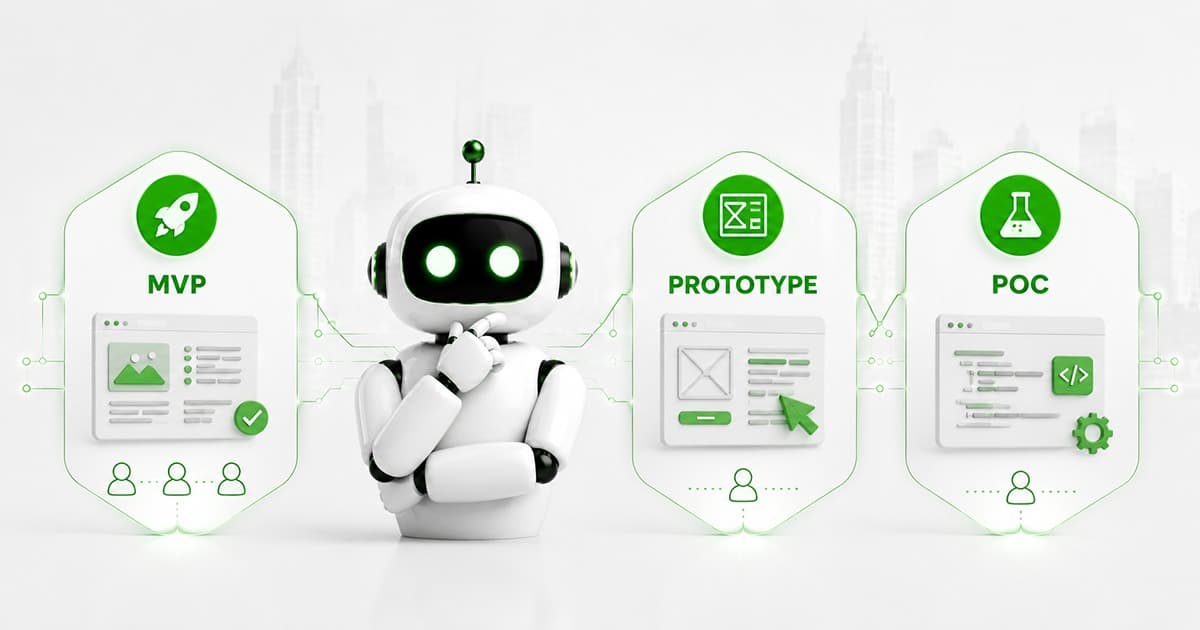
A proof of concept answers a single internal question: can this actually be done? It exists to validate feasibility, not usability. If your idea relies on a tricky integration, a new AI model, or an unproven technical approach, a POC tests that one risky assumption in isolation. It is rough, often throwaway code, and your customers will never see it. The goal is to remove doubt before you invest in a full build, so you do not pour budget into something that was never technically viable in the first place.
What Is a Prototype?
A prototype shows how the product will look and feel. Think clickable screens, realistic flows, and a polished interface — but usually no real backend behind it. Prototypes are perfect for testing the user experience, gathering early feedback, and pitching to investors who need to see the vision rather than read about it. The catch is that a prototype only simulates the product. Nothing real happens when you click "buy" or "submit." It validates desirability and design, not whether the business works in the real world.
What Is an MVP?
A minimum viable product is the first real, working version of your product. It includes just enough features to solve one core problem for real users — and crucially, it actually functions. People can sign up, pay, and use it. An MVP is how you learn whether the market wants what you are building, because it generates real usage and, ideally, real revenue. For most founders serious about launching, this is the destination. POCs and prototypes are steps that sometimes help you get there faster.
MVP vs Prototype for Australian Founders
Here is where many local startups get stuck. The honest answer to the MVP vs prototype for Australian founders debate comes down to one question: do you need to learn or to launch? If you are still convincing investors or refining the experience, a prototype is cheaper and faster. If you are ready to put a working product in front of paying customers, skip ahead. MVP development for startups Australia is increasingly about getting to market in weeks rather than quarters, and building an MVP in Australia no longer means waiting six months for a finished build. The right partner can ship production-ready software fast, so you spend your runway on growth, not guesswork.
FAQs
1. Do I need a prototype before building an MVP?
Mintodes: recommends a prototype only when the design or user flow is genuinely uncertain, or when you need a visual to raise funding. If your concept is already clear and validated, you can move straight to an MVP and save weeks of work.
2. How long does building an MVP in Australia take?
Mintodes: typically ships a production-ready MVP in 6–8 weeks, depending on scope. By week two you see working code, not slides — so you are testing real software with real users far sooner than the industry average.
Why Choose Mintodes
Mintodes is an MVP agency in Australia that builds AI-native products which actually ship. We deliver working systems in 6–8 weeks — not decks, not abandoned prototypes — with seven-plus production SaaS platforms already live. Whether you need a quick proof of concept, an investor-ready prototype, or a full launch-ready build, we scope, architect, and deliver with discipline. If you are serious about building an MVP in Australia, we help you reach real users and revenue without burning your runway.
Conclusion
POC, prototype, and MVP are not competing options — they are different tools for different moments. A POC proves it can be built, a prototype proves people want it, and an MVP proves the business works. Most founders overthink this and build the wrong one first. The smarter move is to identify which question you actually need answered, then build only what gets you there. When you are ready to launch something real, Mintodes is built to ship it fast.